
Progrogramming
Basics
- Introduction
- Why Computers Were Invented?
- How Computers Work?
- What Can a Computer Actually Do?
- Programming Languages
- Programming Terminology
- Programming Terminology Grouping
- Storage Family
- Task Execution Family
- Input & Output Family
- Decision Family
- Repetition Family
- Collection Family
- Object-Oriented Programming (OOP)
- Access & Security Fundamentals
- Understanding Errors and Exception Handling
- How Applications Communicate Using APIs
- Understanding Databases
- Understanding Web and App Flow
- Understanding File Systems
- Understanding the Development Process
- Understanding Team Collaboration
- Understanding Software Performance
- Understanding the Mobile App Ecosystem
- How Websites Reach Your Screen
- How Computers Learn Like Humans
- Why Some Programming Terms Appear Everywhere
Lesson 7
Understanding Data, Data Type, and Size
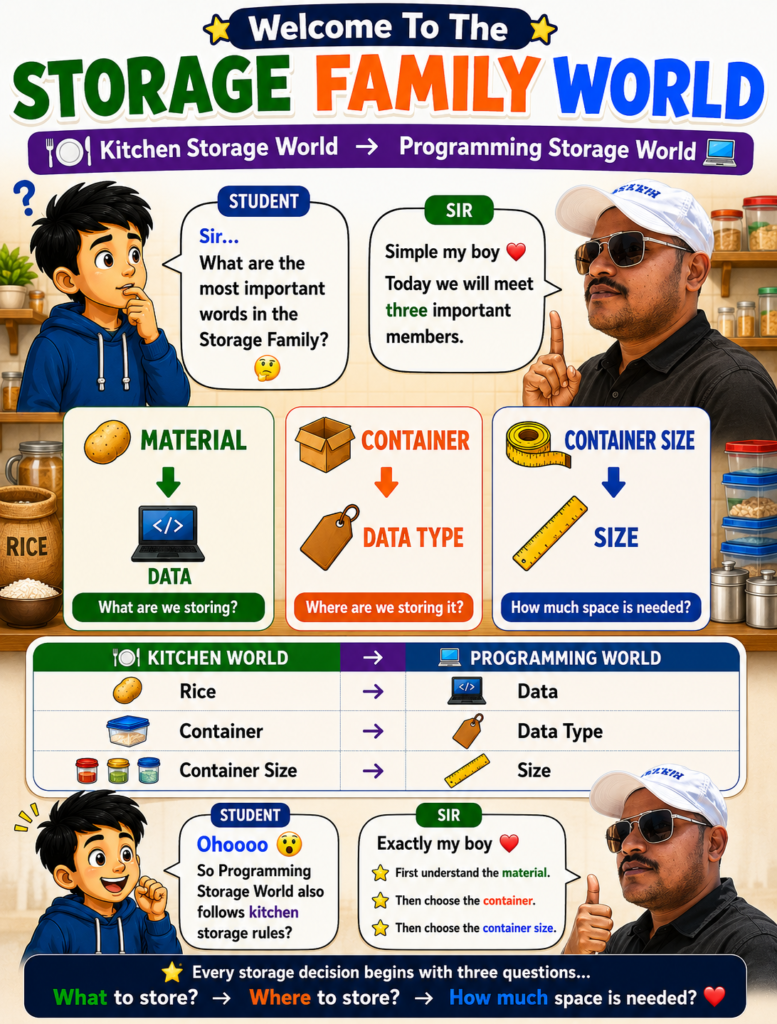
Every piece of information stored in a computer follows three simple rules: What, Where, and How Much.
🤔 Why This Matters
When beginners hear terms like Data, Data Type, and Size, they often feel these are complicated programming concepts.
😵 But in reality, we use the same ideas every day in our kitchens.
Imagine storing food at home.
🥔 First, you decide what material you want to store.
📦 Then, you choose the right container.
📏 Finally, you choose the right container size.
The same logic exists inside computers.
💻 Every storage decision begins with three questions:
❓ What information are we storing?
❓ Where should we store it?
❓ How much space will it need?
The answers to these questions are:
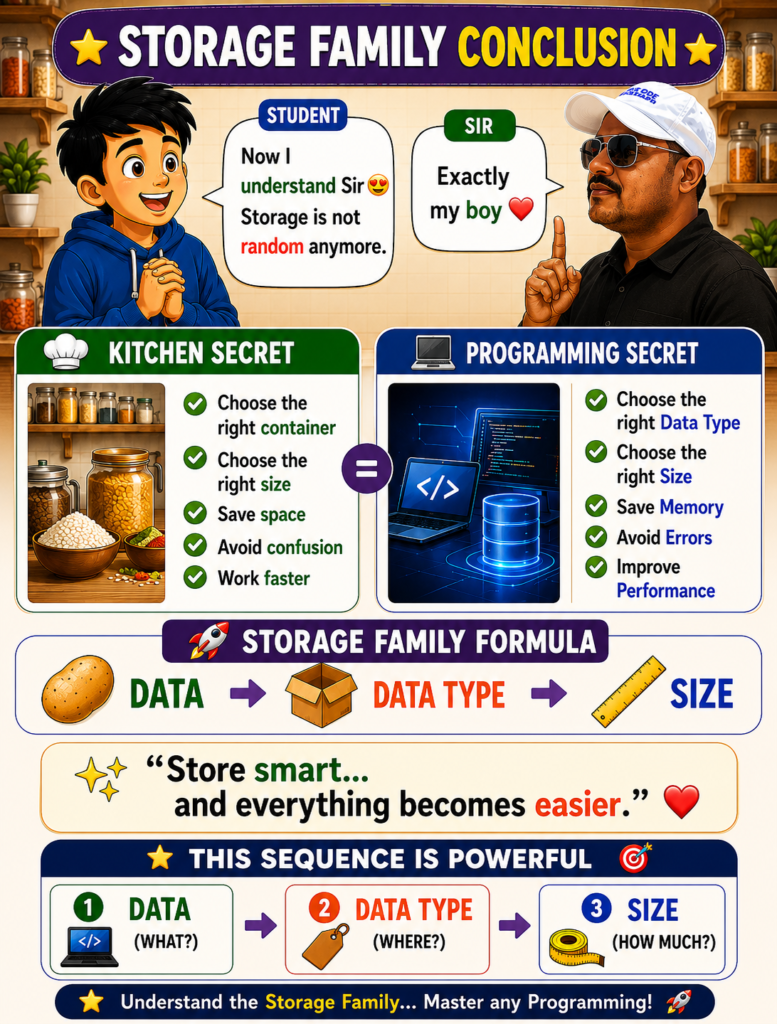
🥔 Data → What we store
📦 Data Type → Where we store it
📏 Size → How much space is needed
Once you understand these three concepts, most programming storage terminology becomes surprisingly simple.
Remember Forever ❤️
Think about kitchen storage:
🍚 Rice = Material
🫙 Container = Storage Box
📏 Container Size = Capacity
Now map it to programming:
💻 Data = Information
🏷️ Data Type = Information Container
📐 Size = Memory Capacity
The formula is always:
🥔 Data
➡️ 📦 Data Type
➡️ 📏 Size
Every programming language follows this same storage principle.
⸻
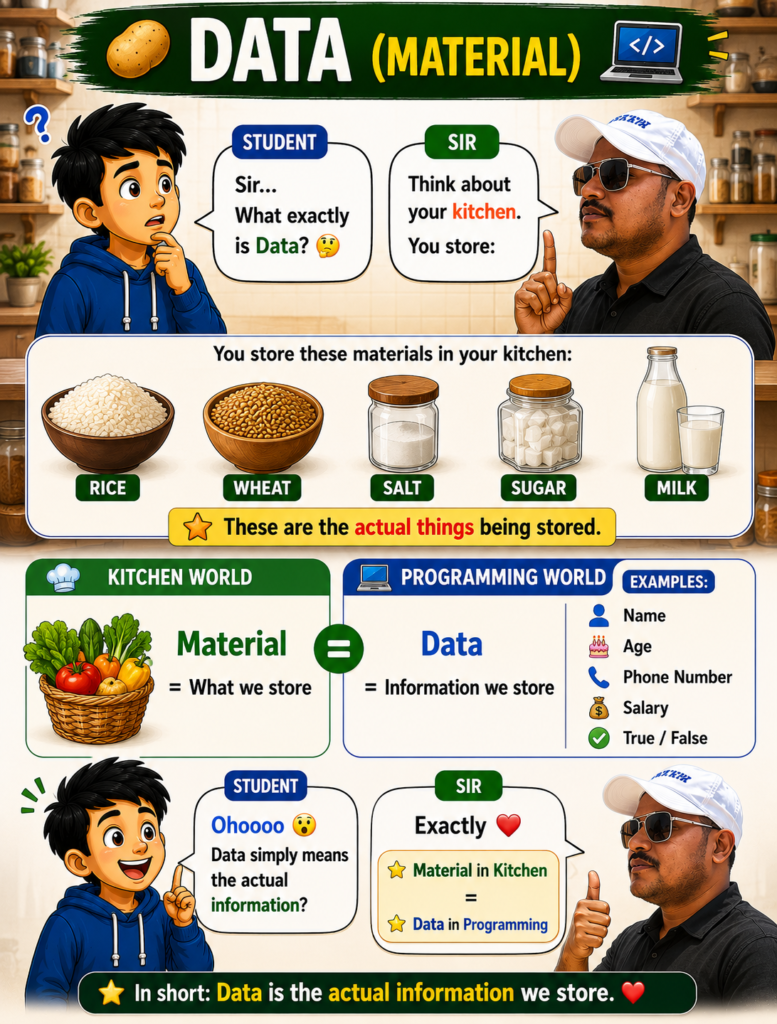
🥔 Data — The Material
Data is the actual information being stored.
Examples:
👤 Name
🎂 Age
📞 Phone Number
💰 Salary
✅ True / False Values
🏠 Address
Just like rice, sugar, milk, and salt are materials in a kitchen, information is the material in programming.
⭐ Data simply means:
The actual information we want to store.
⸻
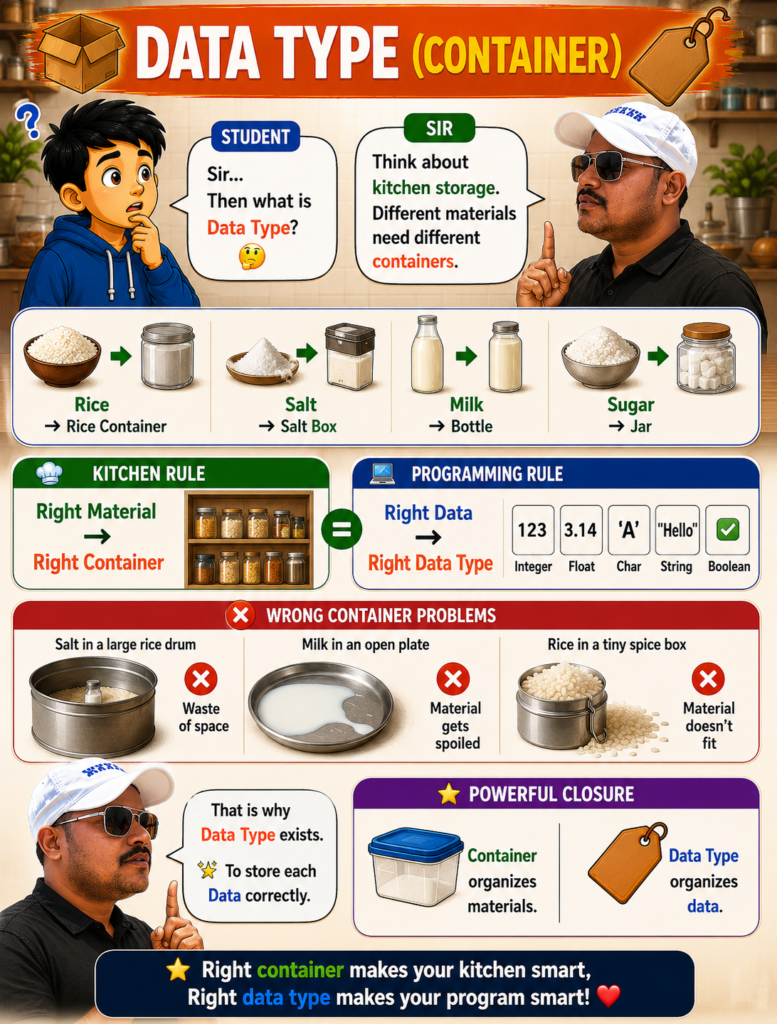
📦 Data Type — The Container
Different materials need different containers.
🥛 Milk needs a bottle.
🧂 Salt needs a jar.
🍚 Rice needs a larger container.
Similarly, different information needs different storage containers.
Examples:
🔢 Integer → Whole Numbers
💲 Float → Decimal Numbers
🔤 String → Text
🔠 Character → Single Character
✅ Boolean → True or False
A Data Type tells the computer:
👉 What kind of information is being stored.
👉 How it should be handled.
👉 How much memory it may require.
⭐ Data Type is the container that organizes data correctly.
⸻
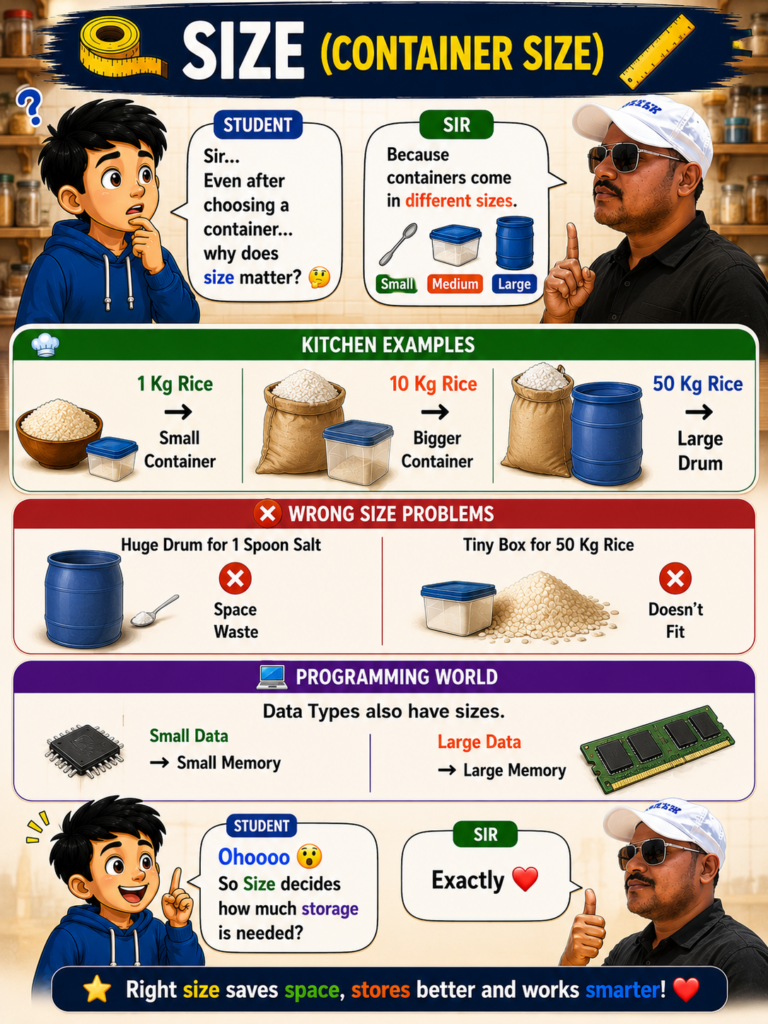
📏 Size — The Container Capacity
Even after choosing a container, size still matters.
🏺 Small container
📦 Medium container
🛢️ Large container
Choosing the wrong size causes problems:
❌ Waste of space
❌ Insufficient capacity
❌ Reduced efficiency
Computers face the same challenge.
Examples:
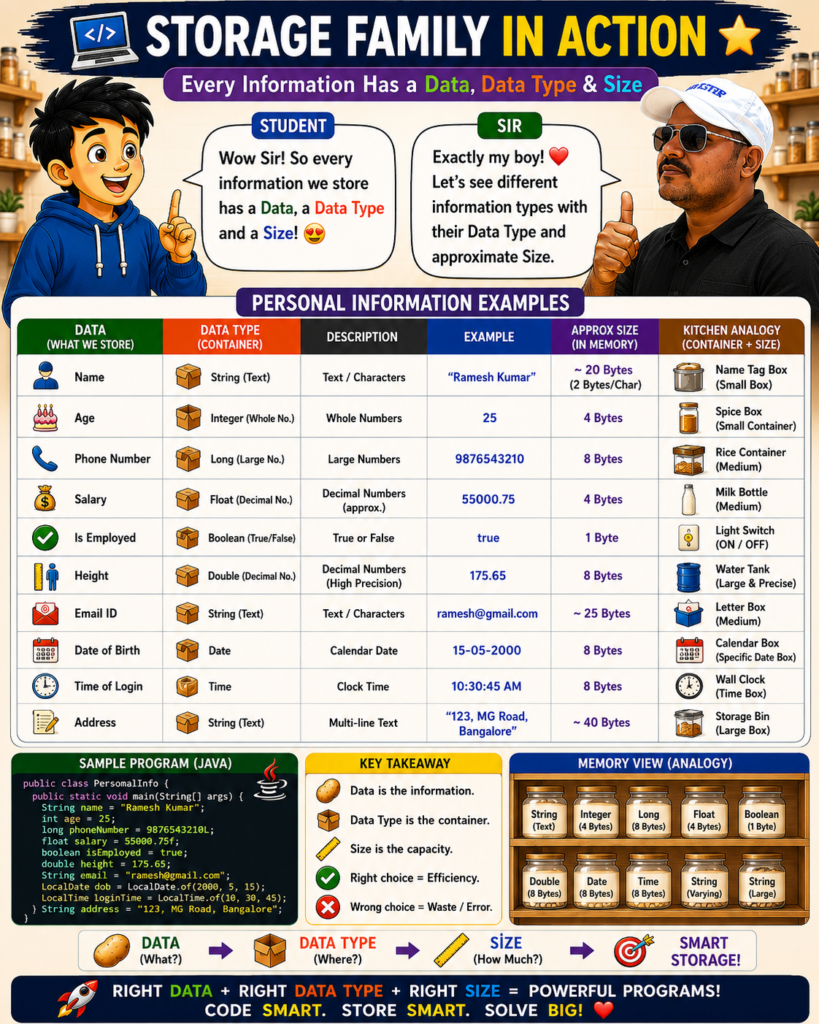
🔹 Integer → 4 Bytes
🔹 Long → 8 Bytes
🔹 Float → 4 Bytes
🔹 Double → 8 Bytes
🔹 Boolean → 1 Byte
The size determines how much memory is consumed.
⭐ Right size saves memory and improves performance.
⸻
🚀 Storage Family Formula
Every storage decision follows:
🥔 Data (What?)
➡️ 📦 Data Type (Where?)
➡️ 📏 Size (How Much?)
This simple sequence powers every application, website, mobile app, database, and enterprise system.
⸻
🌍 Storage Family in Action
Consider a person’s information:
👤 Name → String
🎂 Age → Integer
📞 Phone Number → Long
💰 Salary → Float
✅ Employment Status → Boolean
📧 Email → String
🏠 Address → String
Each piece of information:
✔️ Has Data
✔️ Uses a Data Type
✔️ Occupies Memory Size
Computers apply this rule millions of times every second.
📌 Lesson Summary
• 🥔 Data is the actual information being stored.
• 📦 Data Type is the container used to store the information.
• 📏 Size represents the amount of memory required.
• 🍚 Kitchen storage provides an excellent analogy for understanding computer storage.
• 🔢 Different kinds of data require different data types.
• 💾 Different data types consume different amounts of memory.
• ⚡ Choosing the correct data type improves efficiency and reduces memory waste.
• 🚀 Every application stores information using the sequence:
Data → Data Type → Size
• ❤️ Understanding the Storage Family creates a strong foundation for learning programming.