
Progrogramming
Basics
- Introduction
- Why Computers Were Invented?
- How Computers Work?
- What Can a Computer Actually Do?
- Programming Languages
- Programming Terminology
- Programming Terminology Grouping
- Storage Family
- Task Execution Family
- Input & Output Family
- Decision Family
- Repetition Family
- Collection Family
- Object-Oriented Programming (OOP)
- Access & Security Fundamentals
- Understanding Errors and Exception Handling
- How Applications Communicate Using APIs
- Understanding Databases
- Understanding Web and App Flow
- Understanding File Systems
- Understanding the Development Process
- Understanding Team Collaboration
- Understanding Software Performance
- Understanding the Mobile App Ecosystem
- How Websites Reach Your Screen
- How Computers Learn Like Humans
- Why Some Programming Terms Appear Everywhere
Lesson 3
What Can a Computer Actually Do?
Discover how computers become your loyal mental and physical assistant in everyday life.
🤔 Why This Matters
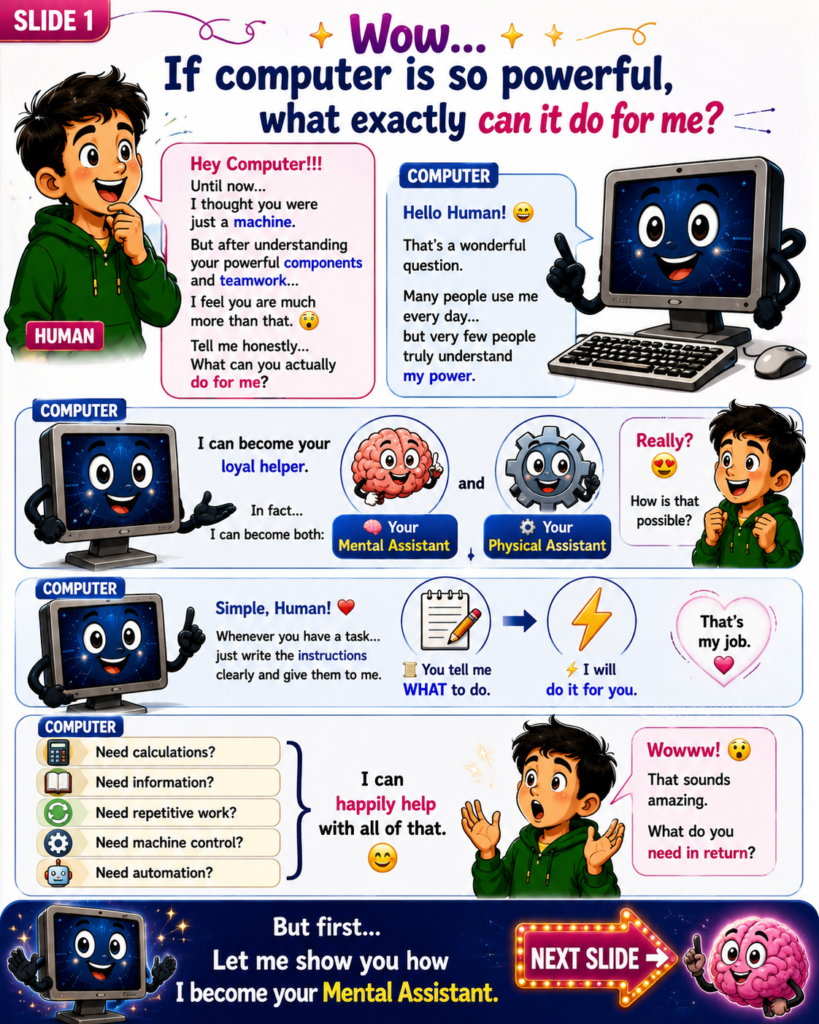
Many people use computers every day but think of them as nothing more than machines. We use them for work, study, communication, entertainment, and countless other activities without truly understanding the enormous value they provide behind the scenes.
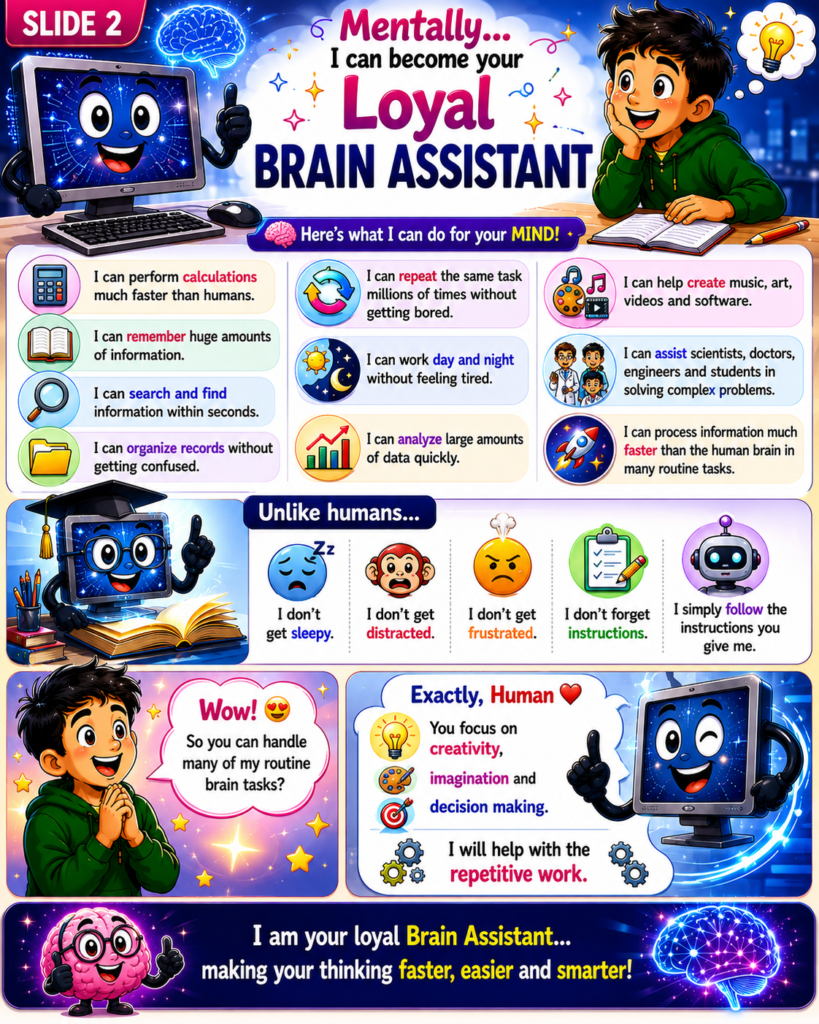
🧠 A computer can become your mental assistant. It can perform calculations in seconds, store vast amounts of information, search through data instantly, organize records, analyze trends, and repeat routine tasks without becoming tired or distracted. This allows humans to focus more on creativity, imagination, learning, and decision-making.
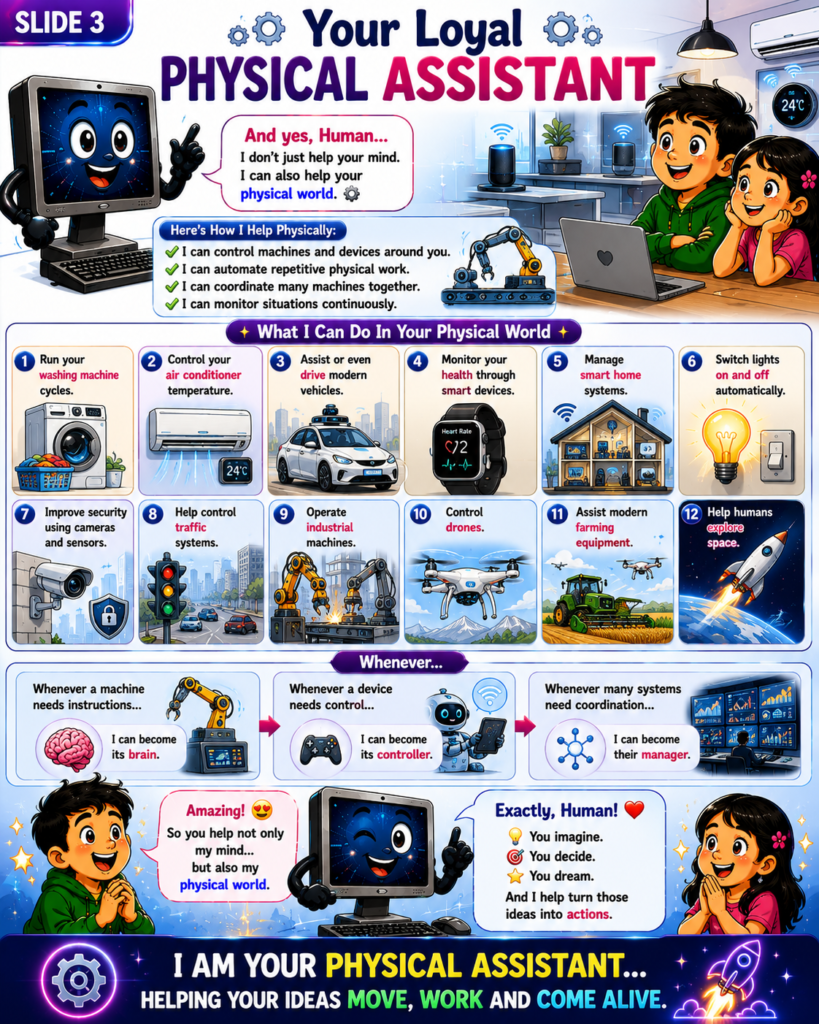
⚙️ A computer can also become your physical assistant. Through automation and connected devices, computers can control machines, monitor environments, operate industrial equipment, manage smart homes, assist transportation systems, and coordinate complex physical processes. They transform ideas into actions in the real world.
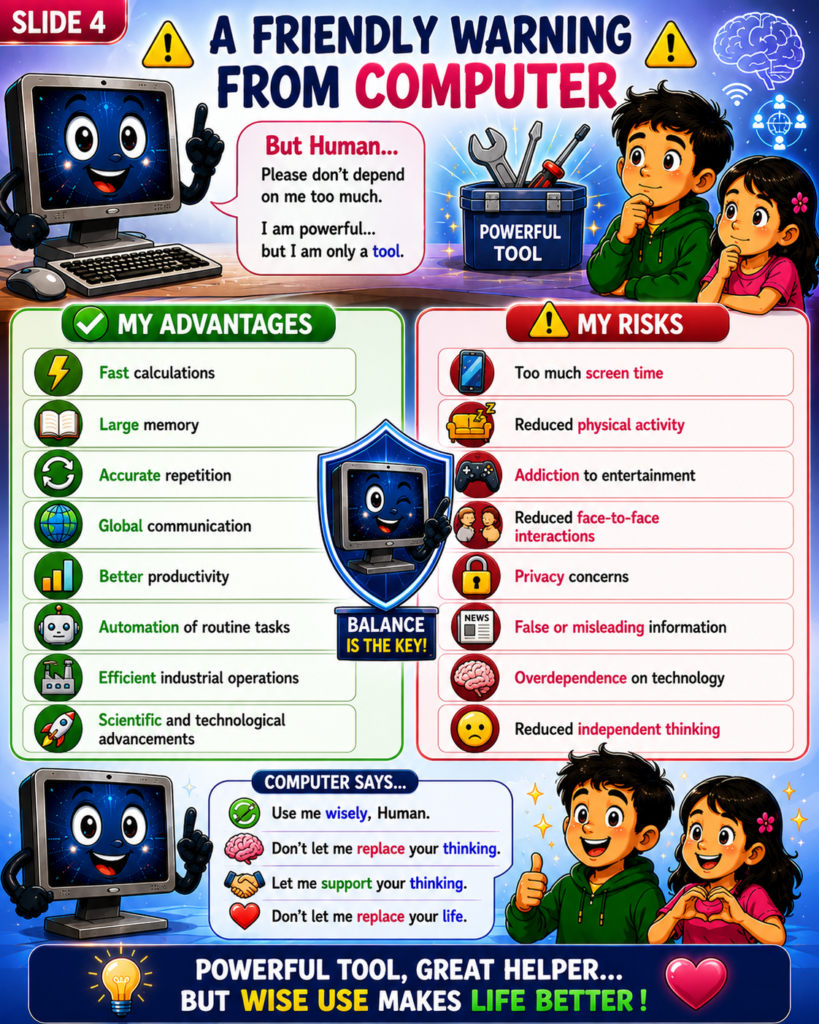
⚠️ However, computers are powerful tools, not replacements for human intelligence. While they can process information faster and perform repetitive work efficiently, they cannot replace human wisdom, values, relationships, emotions, and life experiences. Technology should support human life, not dominate it.
🌟 The greatest benefit comes when humans and computers work together. Computers handle repetitive and data-intensive tasks while humans focus on creativity, critical thinking, relationships, innovation, and purpose. This partnership is what makes technology truly powerful.
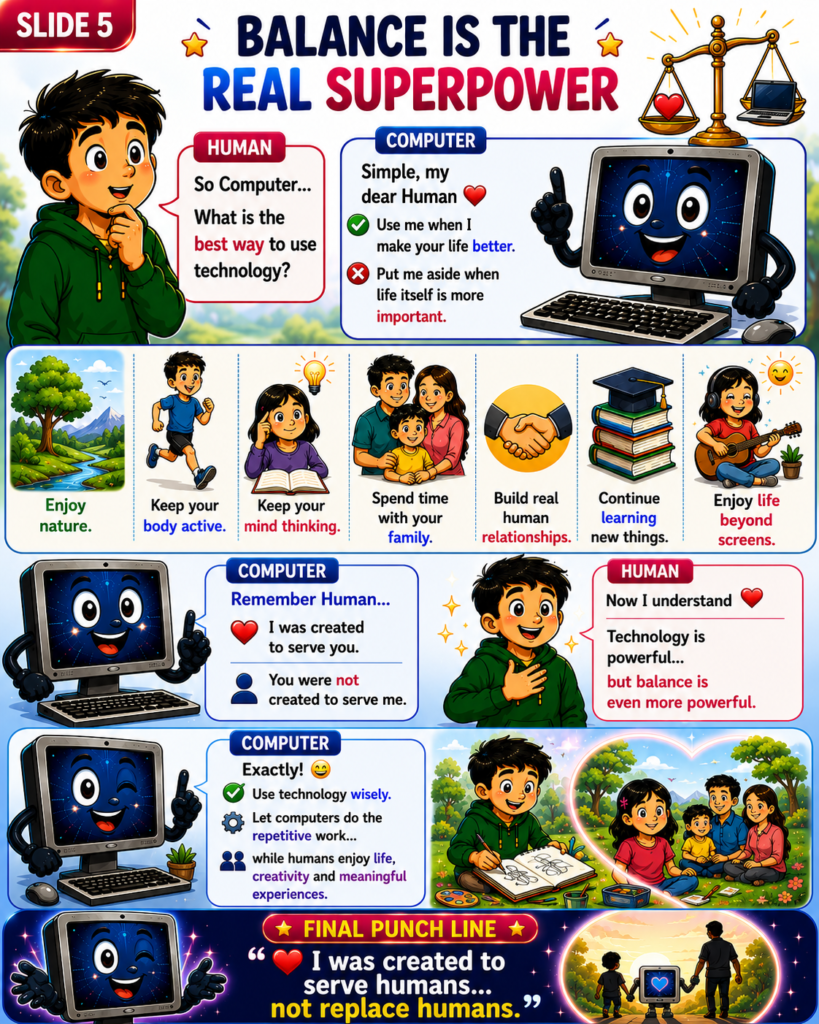
Remember Forever ❤️
A computer can help in two powerful ways:
🧠 Mental Assistant
➡️ Calculations
➡️ Information Storage
➡️ Searching
➡️ Analysis
➡️ Repetitive Thinking Tasks
⚙️ Physical Assistant
➡️ Automation
➡️ Machine Control
➡️ Smart Devices
➡️ Industrial Systems
➡️ Real-World Actions
But always remember:
❤️ Computers were created to serve humans.
🚫 Humans were not created to serve computers.
🌟 Technology is most powerful when used with balance and wisdom.
📌 Lesson Summary
• 🧠 Computers act as powerful mental assistants by processing, storing, and analyzing information.
• 📚 They can remember, search, organize, and retrieve huge amounts of data quickly.
• ⚙️ Computers can control machines, devices, and automated systems in the physical world.
• 🏠 Modern technologies such as smart homes, drones, vehicles, and industrial systems rely heavily on computers.
• ⚡ Computers excel at repetitive tasks and high-speed processing.
• ⚠️ Overdependence on technology can reduce independent thinking and create unhealthy habits.
• ❤️ Computers should support human thinking, not replace it.
• 🌳 A balanced life includes technology, learning, relationships, health, creativity, and real-world experiences.
• 🚀 The best results happen when humans provide imagination, creativity, judgment, and purpose while computers provide speed, accuracy, automation, and execution.