
Progrogramming
Basics
- Introduction
- Why Computers Were Invented?
- How Computers Work?
- What Can a Computer Actually Do?
- Programming Languages
- Programming Terminology
- Programming Terminology Grouping
- Storage Family
- Task Execution Family
- Input & Output Family
- Decision Family
- Repetition Family
- Collection Family
- Object-Oriented Programming (OOP)
- Access & Security Fundamentals
- Understanding Errors and Exception Handling
- How Applications Communicate Using APIs
- Understanding Databases
- Understanding Web and App Flow
- Understanding File Systems
- Understanding the Development Process
- Understanding Team Collaboration
- Understanding Software Performance
- Understanding the Mobile App Ecosystem
- How Websites Reach Your Screen
- How Computers Learn Like Humans
- Why Some Programming Terms Appear Everywhere
🤔 Why This Matters
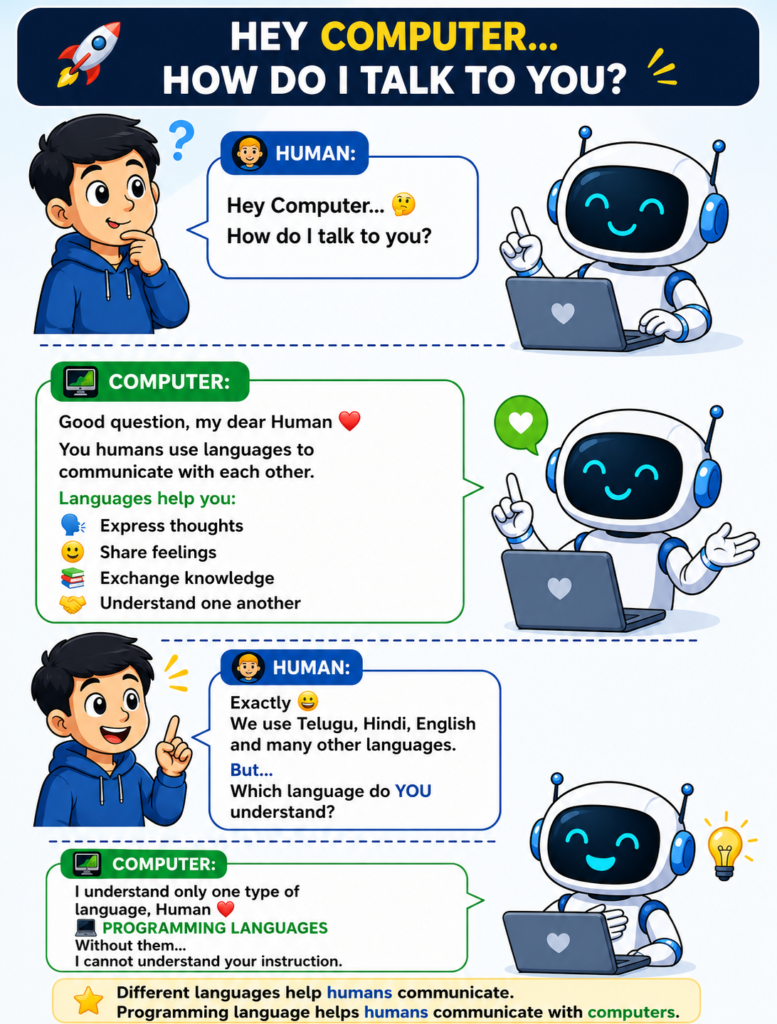
Every day we talk to people using languages such as Telugu, Hindi, English, Japanese, Chinese, and many others. Languages help us express ideas, share knowledge, ask questions, and work together.
💬 Humans communicate with humans using spoken and written languages.
💻 Computers, however, cannot understand Telugu, Hindi, or English directly. They require instructions in a language they can understand. These special languages are called Programming Languages.
🧑💻 A programming language acts as a bridge between human thinking and computer execution. It allows us to tell computers what to do, how to do it, and when to do it.
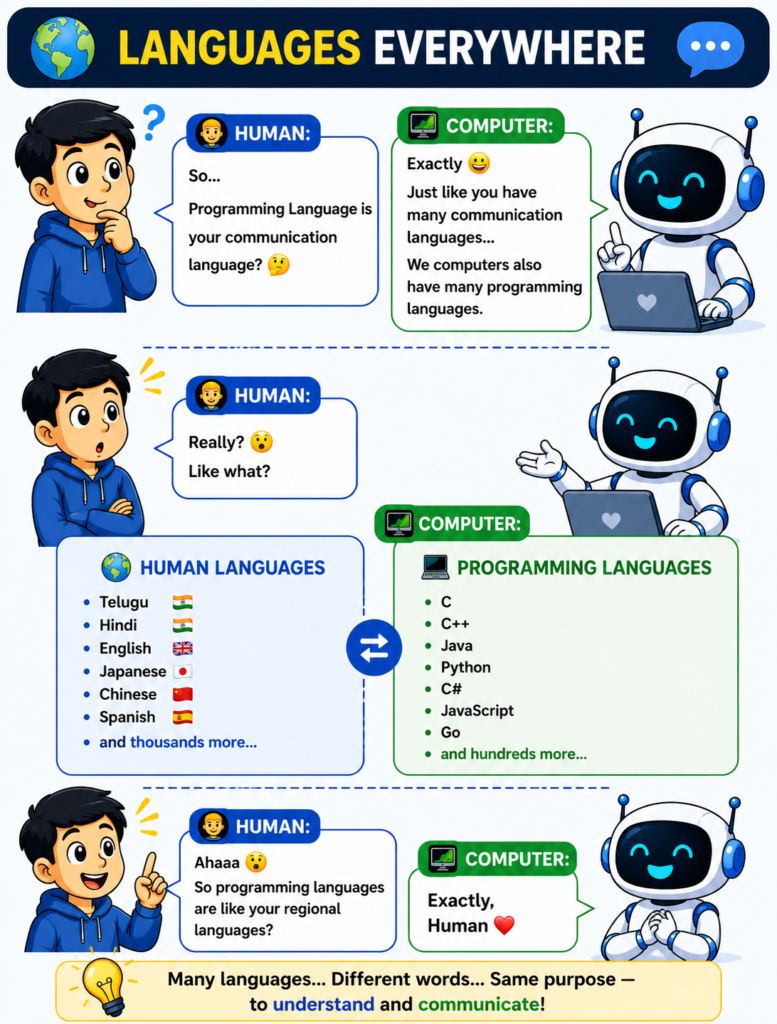
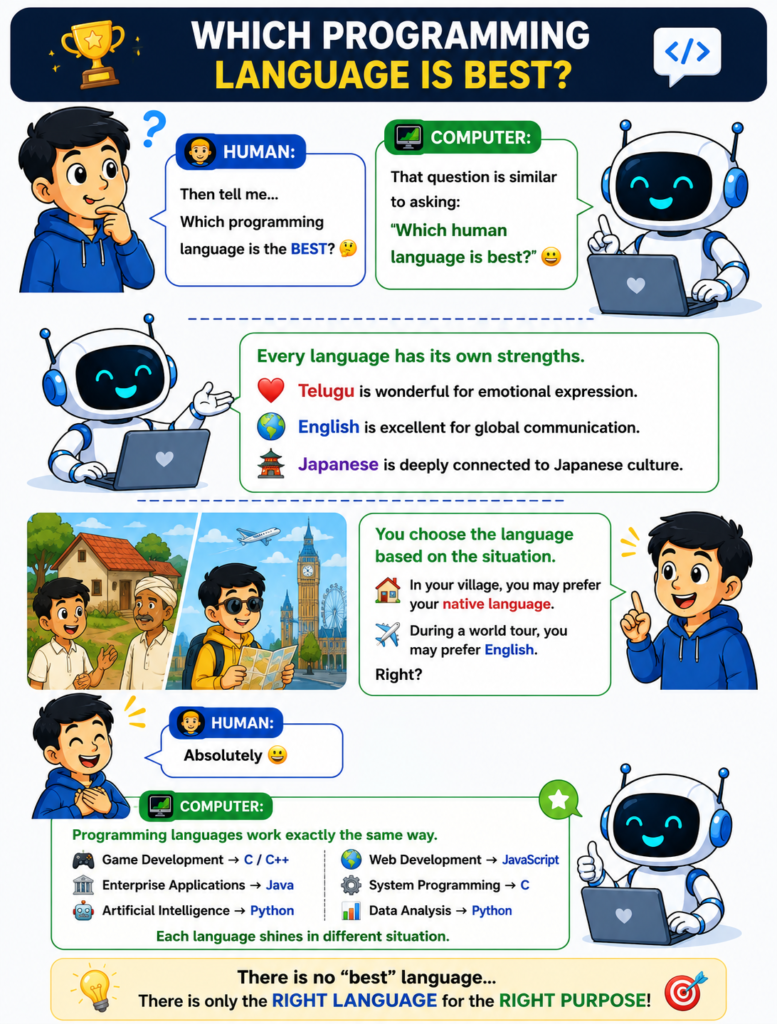
🌍 Just as humans use different languages for different regions and situations, computers use different programming languages for different types of problems. Some languages are excellent for web applications, some are designed for enterprise systems, some specialize in artificial intelligence, and others focus on system-level programming.
⚙️ Many beginners ask:
“Which programming language is the best?”
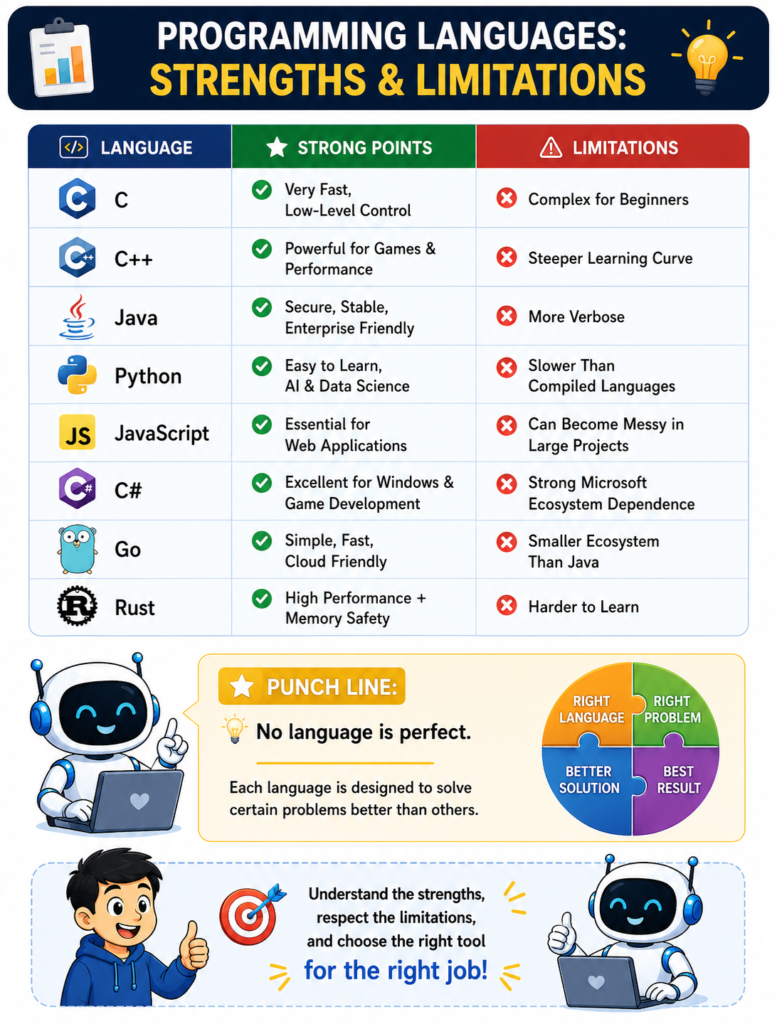
The reality is that there is no universal best language. Every programming language has strengths, limitations, and ideal use cases.
🚀 Modern software systems rarely use a single language. Real-world applications often combine multiple technologies together. For example, a web application may use JavaScript for the user interface, Java for backend services, SQL for databases, and Python for AI capabilities.
Understanding programming languages is the first step toward understanding how software is created and how humans communicate with computers.
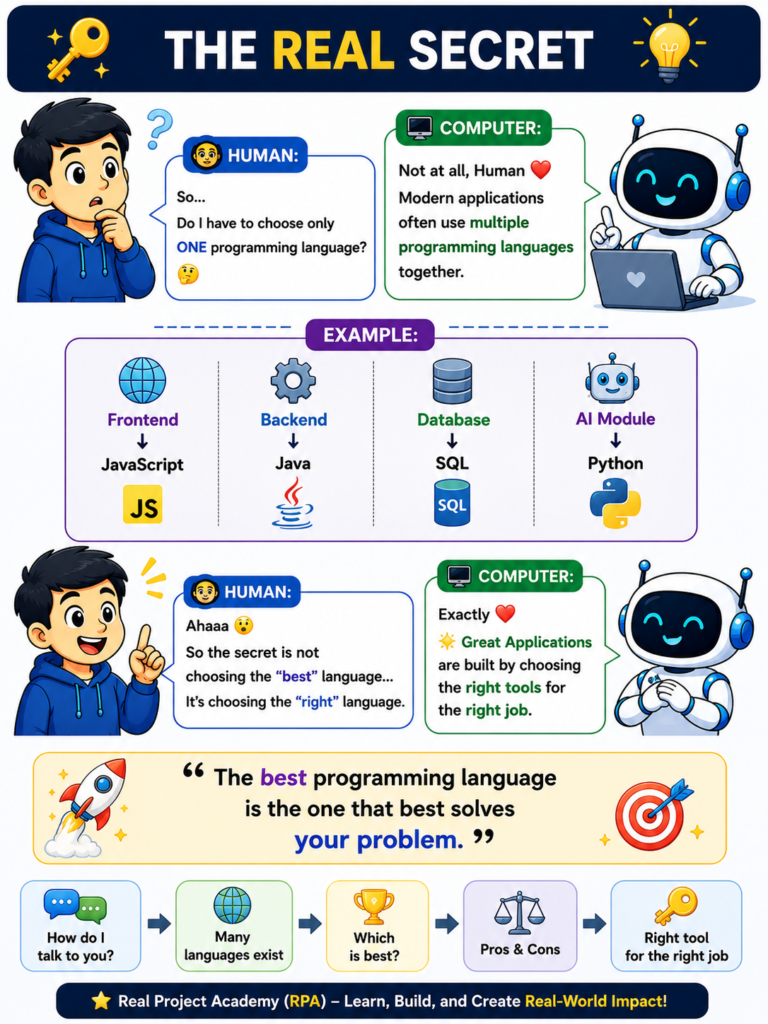
Remember Forever ❤️
Humans speak languages to communicate with people.
💬 Telugu
💬 Hindi
💬 English
💬 Japanese
💬 Chinese
Computers use programming languages to communicate with machines.
💻 C
💻 C++
💻 Java
💻 Python
💻 JavaScript
💻 C#
💻 Go
There is no “best” language.
🎯 There is only the right language for the right problem.
Modern applications often combine multiple programming languages working together.
🌟 Great software is built by choosing the right tools for the right job.
📌 Lesson Summary
• 💬 Human languages help people communicate with one another.
• 💻 Programming languages help humans communicate with computers.
• 🌍 There are many programming languages, just as there are many human languages.
• 🎯 Different programming languages are designed for different purposes and problem domains.
• ⚖️ Every programming language has strengths and limitations.
• 🚀 There is no universally best programming language.
• 🏗️ Real-world applications often use multiple programming languages together.
• 🔧 Successful software development is about choosing the right language for the right job.
• 🌟 Great programmers focus less on finding the “best” language and more on solving real-world problems effectively.
• ❤️ Programming languages are simply tools that transform human ideas into working software.