
Progrogramming
Basics
- Introduction
- Why Computers Were Invented?
- How Computers Work?
- What Can a Computer Actually Do?
- Programming Languages
- Programming Terminology
- Programming Terminology Grouping
- Storage Family
- Task Execution Family
- Input & Output Family
- Decision Family
- Repetition Family
- Collection Family
- Object-Oriented Programming (OOP)
- Access & Security Fundamentals
- Understanding Errors and Exception Handling
- How Applications Communicate Using APIs
- Understanding Databases
- Understanding Web and App Flow
- Understanding File Systems
- Understanding the Development Process
- Understanding Team Collaboration
- Understanding Software Performance
- Understanding the Mobile App Ecosystem
- How Websites Reach Your Screen
- How Computers Learn Like Humans
- Why Some Programming Terms Appear Everywhere
Lesson 12
How Computers Organize Information Efficiently
The fascinating journey from apartment management to organized computer collections.
🤔 Why This Matters
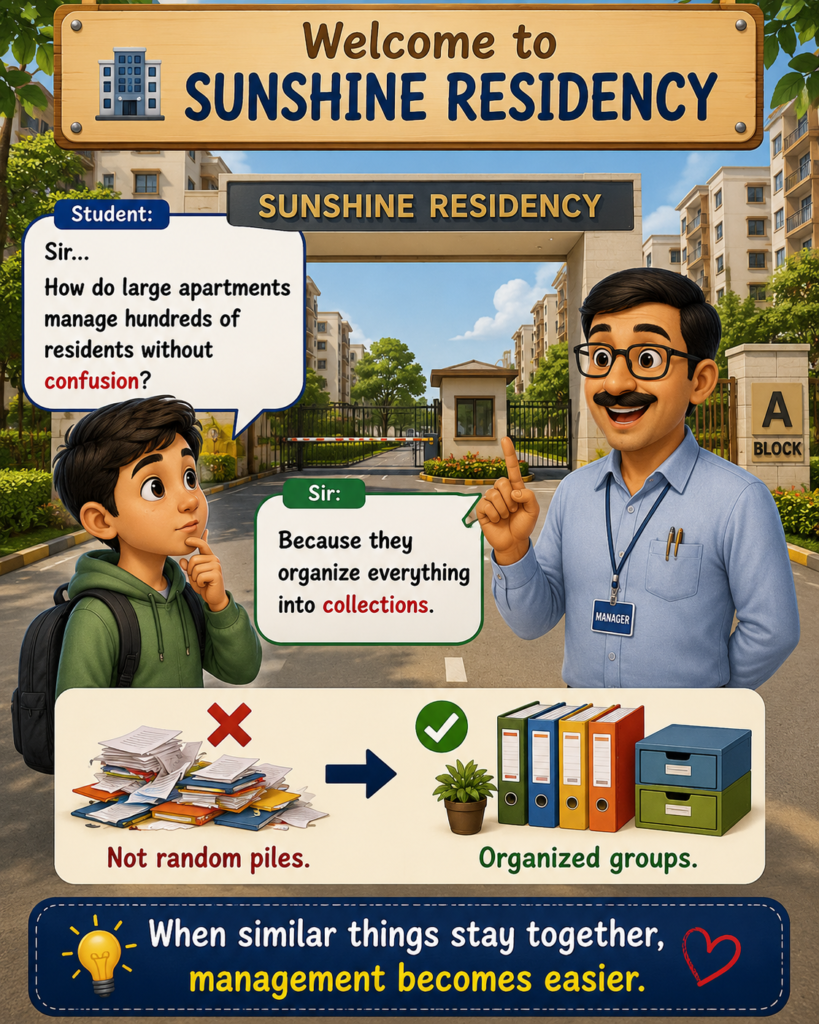
Imagine a large apartment complex with hundreds of residents.
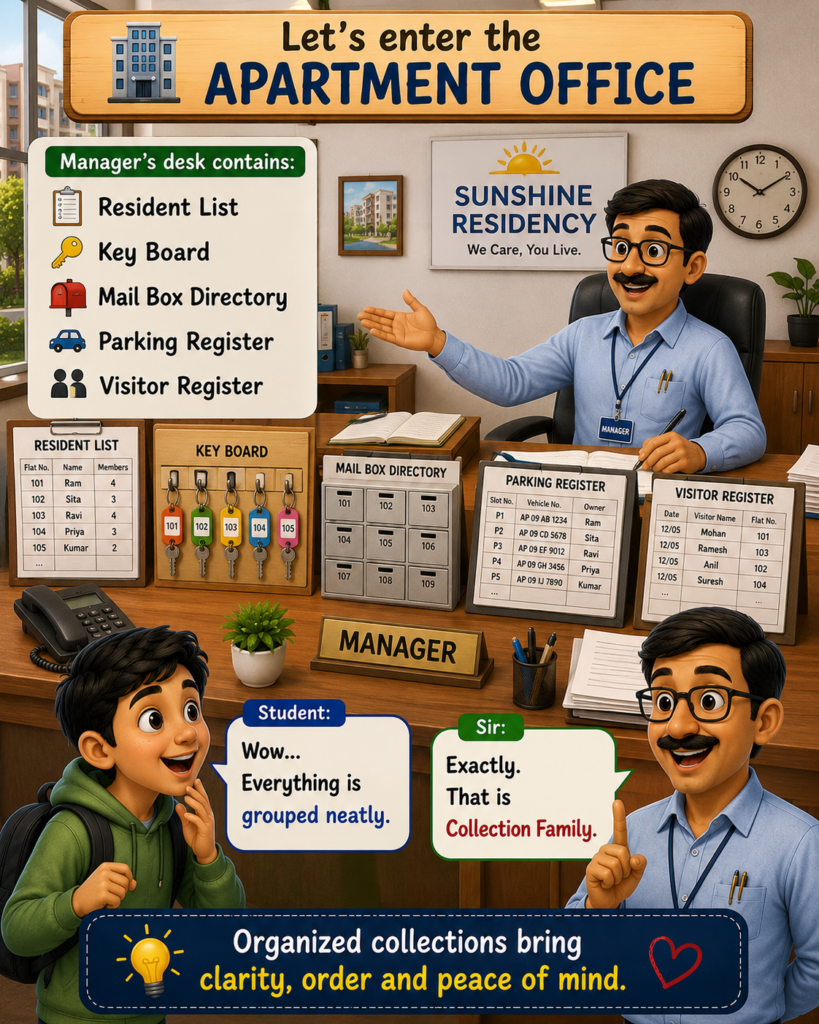
🏢 Every day, the management office handles:
📋 Resident Lists
🔑 Key Boards
📬 Mail Box Directories
🚗 Parking Registers
👥 Visitor Registers
Without organization, everything would become confusing.
Papers would be scattered.
Keys would be lost.
Visitors would be difficult to track.
Finding information would take a long time.
Smart apartment managers solve this problem by organizing related information into collections.
Instead of keeping random piles of data, they group similar things together in a structured way.
💡 Computers face the exact same challenge.
Modern applications handle thousands or even millions of pieces of information.
For example:
🛒 Online stores manage products.
🏦 Banks manage customer accounts.
📱 Social media platforms manage users and posts.
🎓 Schools manage students and courses.
Without proper organization, software would become slow, difficult to maintain, and prone to errors.
That is why programming languages provide the Collection Family.
The Collection Family helps computers:
📦 Store multiple items together
🔍 Find information quickly
📋 Maintain order when needed
🚫 Prevent duplicates when required
🔑 Connect related information using keys and values
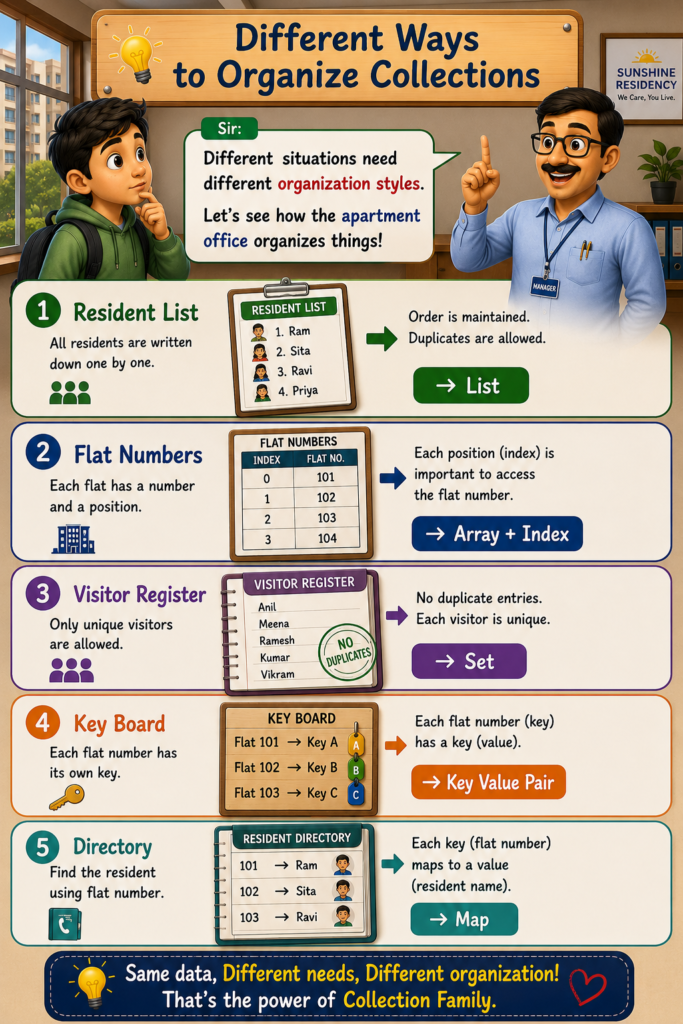
Different situations require different collection types.
For example:
📋 List
Keeps items in order.
Duplicates are allowed.
🏢 Similar to a Resident List.
⸻
🔢 Array + Index
Stores items at specific positions.
Each position can be accessed directly.
🏢 Similar to Flat Numbers.
⸻
🚫 Set
Stores only unique items.
Duplicates are not allowed.
🏢 Similar to a Visitor Register.
⸻
🔑 Key-Value Pair
Connects one piece of information to another.
🏢 Similar to Flat Number → Key.
⸻
🗺️ Map
Stores data using keys and values.
🏢 Similar to a Resident Directory where a flat number points to a resident.
The Collection Family is one of the most important foundations in programming because almost every software application depends on organized data.
🚀 The better information is organized, the smarter and faster a program becomes.
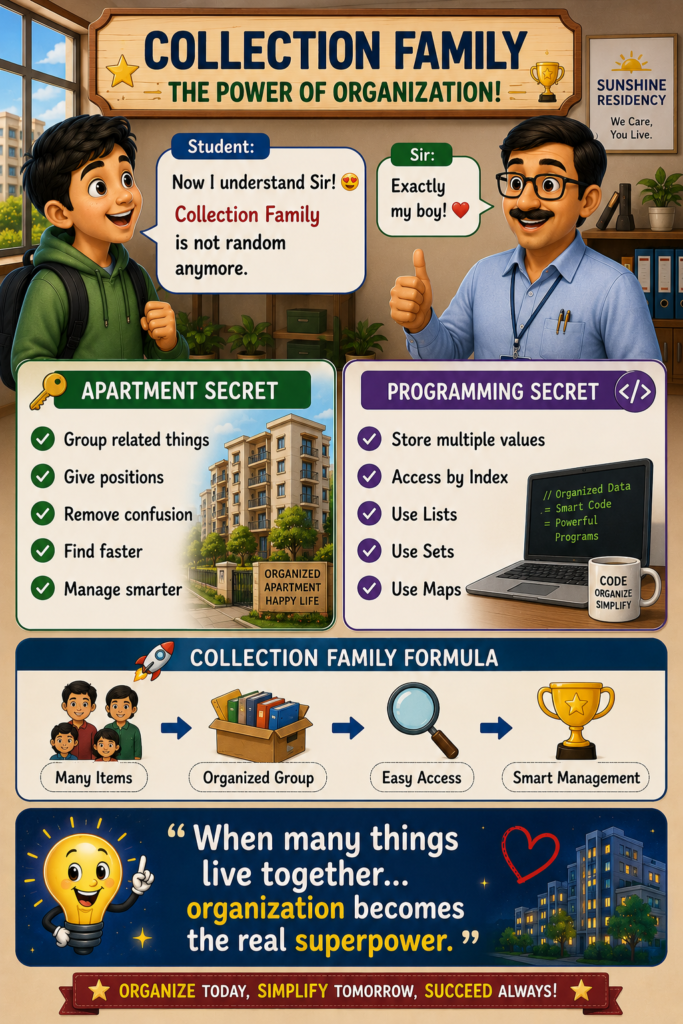
Remember Forever ❤️
When many things live together…
organization becomes the real superpower.
The Collection Family follows a simple formula:
👥 Many Items
➡️ 📦 Organized Group
➡️ 🔍 Easy Access
➡️ 🏆 Smart Management
Apartment managers use organized registers.
Computers use organized collections.
Different names.
Same idea.
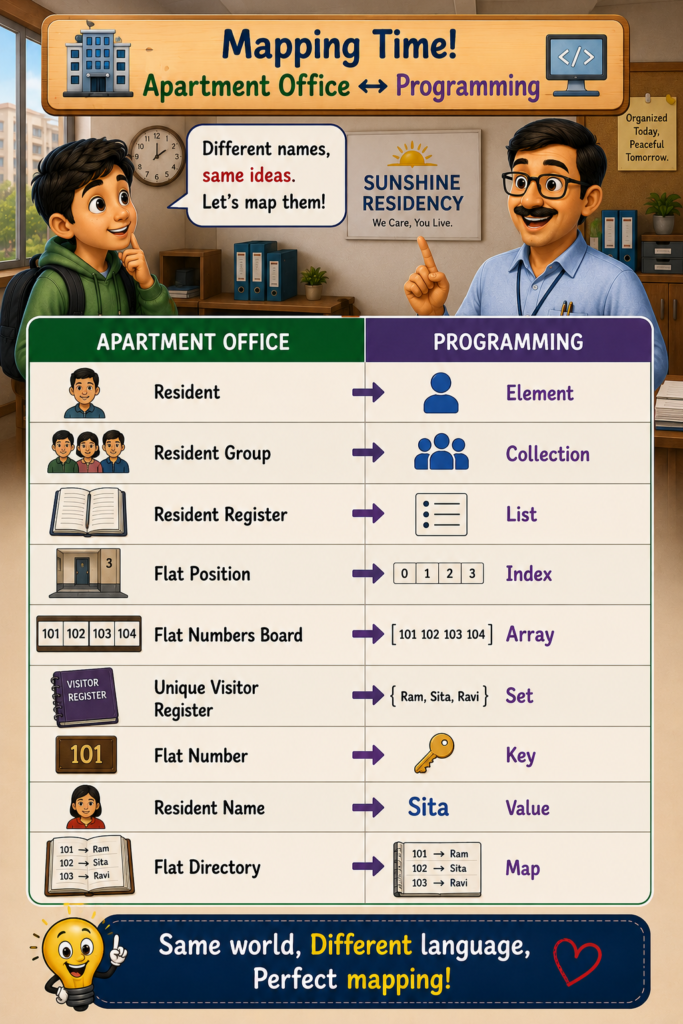
🏢 Apartment Office
➡️ 💻 Programming World
Resident Register
➡️ List
Flat Position
➡️ Index
Flat Numbers Board
➡️ Array
Unique Visitor Register
➡️ Set
Flat Number
➡️ Key
Resident Name
➡️ Value
Resident Directory
➡️ Map
🌟 Good organization removes confusion and makes management easier.
📌 Lesson Summary
• 🏢 Large apartment communities manage information using organized collections.
• 📦 Collections group related information together.
• 🔍 Organized information is easier to find, manage, and update.
• 📋 Lists maintain order and allow duplicate values.
• 🔢 Arrays store data using positions called indexes.
• 🚫 Sets store only unique values and prevent duplicates.
• 🔑 Keys identify information uniquely.
• 🗺️ Maps connect keys to values for fast lookup.
• 💻 Collection concepts in programming mirror organization systems used in real life.
• 🚀 Collections help software manage large amounts of data efficiently.
• 🌟 Different problems require different collection types.
• ❤️ Organization is the foundation of smart software design.
⸻
❤️ This is another beautiful addition to your RWP story universe:
🪨 Storage Family → Information exists
⚡ Task Execution Family → Work gets done
📥📤 Input/Output Family → Communication happens
❓ Decision Family → Computers choose actions
🔄 Repetition Family → Computers repeat actions
📦 Collection Family → Computers organize information
The Sunshine Residency Story is a particularly strong real-world analogy because every collection concept naturally appears inside the apartment office:
📋 Resident List → List
🔢 Flat Positions → Index
🏢 Flat Numbers Board → Array
🚫 Visitor Register → Set
🔑 Flat Number → Key
👤 Resident Name → Value
🗺️ Resident Directory → Map
This creates a very natural bridge into Core Java topics such as ArrayList, LinkedList, HashSet, TreeSet, HashMap, LinkedHashMap, TreeMap, and Collections Framework fundamentals.